



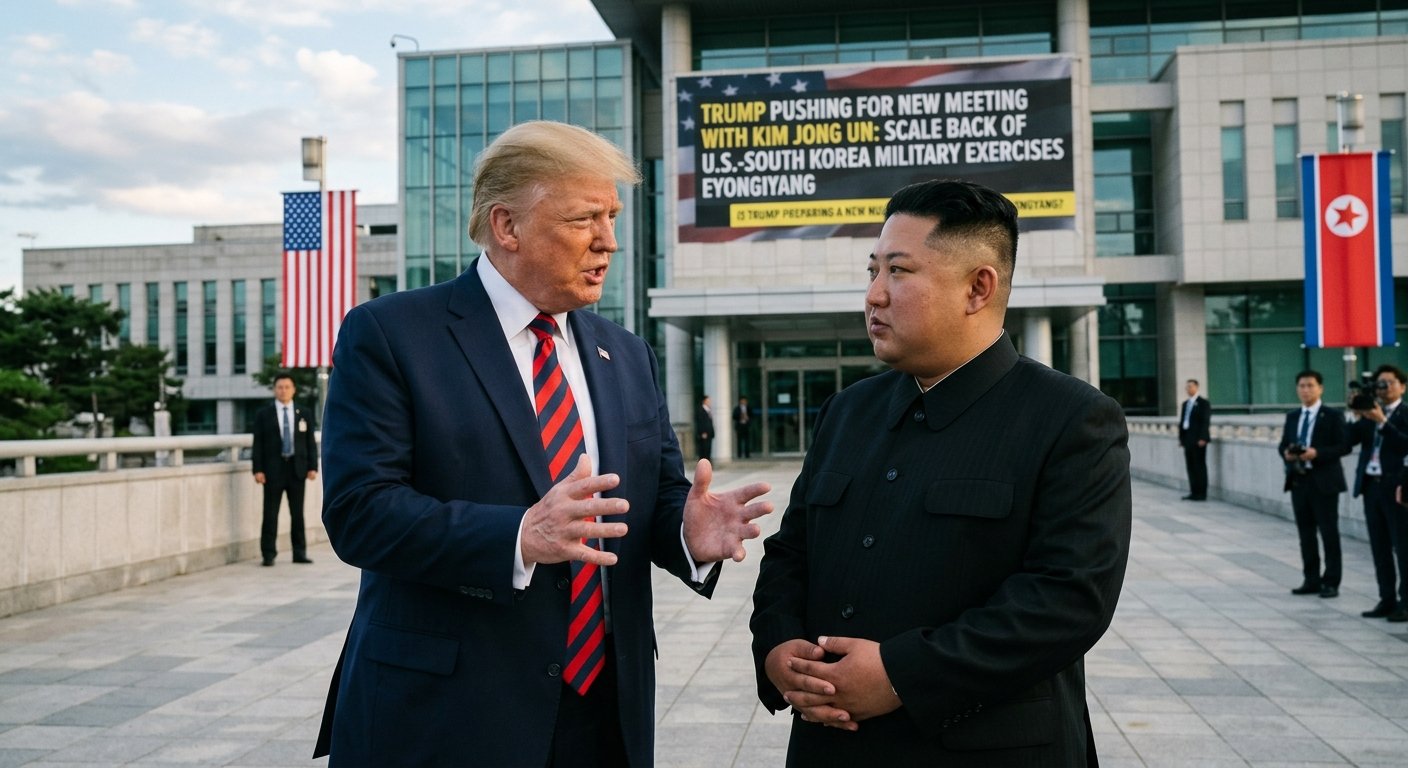
WASHINGTON — President Donald Trump is quietly reopening one of the most consequential diplomatic channels of his first presidency, sending indirect messages to North Korean leader Kim Jong Un that he wants to meet him as soon as possible.
The objective is clear: Trump wants to bring Kim back to the negotiating table and persuade him to abandon, or at least substantially restrain, North Korea’s nuclear ambitions.
But this time, Trump is preparing the ground differently.
His renewed push for a meeting with Kim has come almost simultaneously with Washington’s abrupt decision to reduce the scale of major U.S.-South Korean military exercises—a move that has sent shockwaves through Seoul and raised questions about whether Trump is once again willing to reshape an alliance in pursuit of a personal diplomatic breakthrough.
The Wall Street Journal has reported that Trump is pushing aides to arrange another meeting with Kim as early as this fall, potentially during his planned November Asia trip for the Asia-Pacific Economic Cooperation summit in Shenzhen, China. Wall Street Journal report on Trump-Kim meeting
Trump Kim Jong Un Meeting: Is The Timing Accidental:
Trump has ordered a substantial reduction in the U.S. military role in the annual Ulchi Freedom Shield exercise with South Korea. The exercise has been shortened from 11 days to five, while elements of field training have been scaled back. South Korean officials have acknowledged that they were not informed in advance of Trump’s directive.
READ NEXT: An Alliance Without a Treaty: How China, Russia, and North Korea Are Redefining Strategic Alignment
Trump has publicly linked the decision to his relationship with Kim.
That makes the military reduction more than a question of training schedules. It is a diplomatic signal.
Washington appears to be telling Pyongyang that Trump is prepared to lower one of the most visible forms of military pressure on North Korea if Kim is willing to reopen direct negotiations.
READ MORE: Trump Pushes for Kim Jong Un Meeting This Year
The strategy has echoes of Trump’s first term, when he suspended or reduced military exercises around his unprecedented summits with Kim in Singapore, Hanoi and at the Korean Demilitarized Zone.
But the geopolitical environment has changed dramatically.
Trump Kim Jong Un Meeting: Is Kim Stronger Now?
North Korea’s nuclear arsenal has expanded, its ballistic-missile capabilities have improved and its strategic relationships with Russia and China have deepened. Pyongyang has also acquired valuable battlefield experience through its military cooperation with Moscow.
The Islamabad Telegraph has previously examined how Trump’s possible return to direct diplomacy with Kim could reshape the Korean Peninsula and challenge the traditional U.S. alliance structure in East Asia. The Islamabad Telegraph: Trump-Kim meeting and the Korean Peninsula
Trump therefore faces a fundamentally different Kim Jong Un from the one he met in 2018.
Kim no longer approaches Washington as an isolated ruler seeking sanctions relief and international legitimacy. He now commands a more capable nuclear state with alternative economic, diplomatic and military partners.
That changes the negotiating equation.
The central danger for Washington is that Trump may believe his personal relationship with Kim can accomplish what traditional diplomacy failed to achieve.
The 2018 Singapore Declaration produced a historic meeting but little concrete progress on denuclearization. The 2019 Hanoi summit collapsed after Trump rejected Kim’s offer as insufficient. The subsequent DMZ meeting failed to restart substantive negotiations.
Yet Trump still appears convinced that personal diplomacy can succeed where bureaucratic diplomacy cannot.
That belief explains the significance of the military drills.
By reducing the exercises, Trump is giving Kim a tangible concession before negotiations have even begun.
Trump’s Middle East Strategy
For Pyongyang, this is strategically valuable.
North Korea has spent decades demanding an end to what it calls hostile U.S.-South Korean military exercises. Trump has now voluntarily reduced them while simultaneously expressing confidence in his relationship with Kim.
The question is what Washington receives in return.
The answer, according to the administration’s stated policy, is denuclearization.
But Kim may have very different objectives.
He wants Washington to accept the reality of North Korea as a nuclear-armed state. The regime has repeatedly strengthened its nuclear doctrine and missile forces precisely because it believes nuclear weapons are essential to regime survival.
That means Trump could enter a new summit seeking denuclearization while Kim enters seeking recognition.
This is where Trump’s new Korea strategy could become explosive.
South Korea may welcome dialogue with Pyongyang, but Seoul also has to calculate what happens if Washington prioritizes a Trump-Kim deal over the security concerns of its treaty ally.
The abrupt reduction in military exercises has already generated unease. South Korean officials were reportedly caught off guard, while President Lee Jae Myung has renewed calls for greater military independence.
The implication is profound.
Trump is increasingly treating alliances through the same transactional lens he has applied to Europe.
For Trump, military cooperation appears increasingly connected to whether allies contribute to American strategic objectives. South Korea’s reluctance to support Washington’s position over Iran and the Strait of Hormuz has added another layer to an already complicated alliance relationship.
The Islamabad Telegraph has also reported on the broader Trump-Xi-Korean Peninsula equation, including the possibility that Trump’s engagement with China could become inseparable from his dealings with Kim. The Islamabad Telegraph: Xi-Trump meeting in South Korea
That is where Beijing enters the equation.
China remains North Korea’s most important economic partner, while Russia has become an increasingly important military partner. Kim therefore has alternatives that did not exist in the same form during Trump’s first presidency.
Tulsi
Trump is consequently not negotiating with a desperate North Korea.
He is negotiating with a North Korea that believes time is on its side.
This could explain the urgency behind Trump’s indirect messages.
The president appears to want the meeting before Kim’s strategic position becomes even stronger—and before America’s wider geopolitical commitments further complicate Washington’s ability to concentrate on East Asia.
Elon Musk
A Trump-Kim summit this fall would therefore not simply represent the revival of an old diplomatic experiment.
It would mark the beginning of a new strategic bargain.
Trump wants Kim to limit the nuclear program.
Kim wants the United States to accept North Korea’s nuclear reality.
South Korea wants to preserve American security guarantees.
China wants to prevent the United States from tightening its military presence around the peninsula.
Russia wants to preserve its growing military relationship with Pyongyang.
Those objectives do not naturally converge.
And that is why the reduction of U.S.-South Korean military exercises may ultimately prove more important than the summit itself.
Trump is already changing the negotiating environment before Kim has even agreed to sit across the table.
The biggest question now is whether Kim will interpret Trump’s outreach as an opportunity for peace—or as evidence that Washington is finally prepared to negotiate from a position of weakness.
If Trump succeeds, he could produce the most dramatic diplomatic breakthrough on the Korean Peninsula in decades.
If he fails, he may discover that he has traded away part of America’s deterrence posture without receiving anything meaningful from Pyongyang.
Trump is once again betting on personal diplomacy. But this time, Kim Jong Un is holding far stronger cards.